Blinkit vs Zepto are two completely different shelves.
We read nine Blinkit dark stores and nine Zepto dark stores in Bengaluru, by hand, on the same day. The two platforms don't just have different brands — they behave nothing alike. One is a uniform, pay-to-play shelf where a handful of brands own most of the ads. The other is patchy, with stores that return an empty shelf and real gaps to exploit.
On Zepto, one brand — Max Protein — bought 70% of every sponsored placement for “protein bar”: 79 of the 113 paid slots we counted, in a category with just six brands on the shelf. Its rivals didn't run zero — they simply got buried under it.
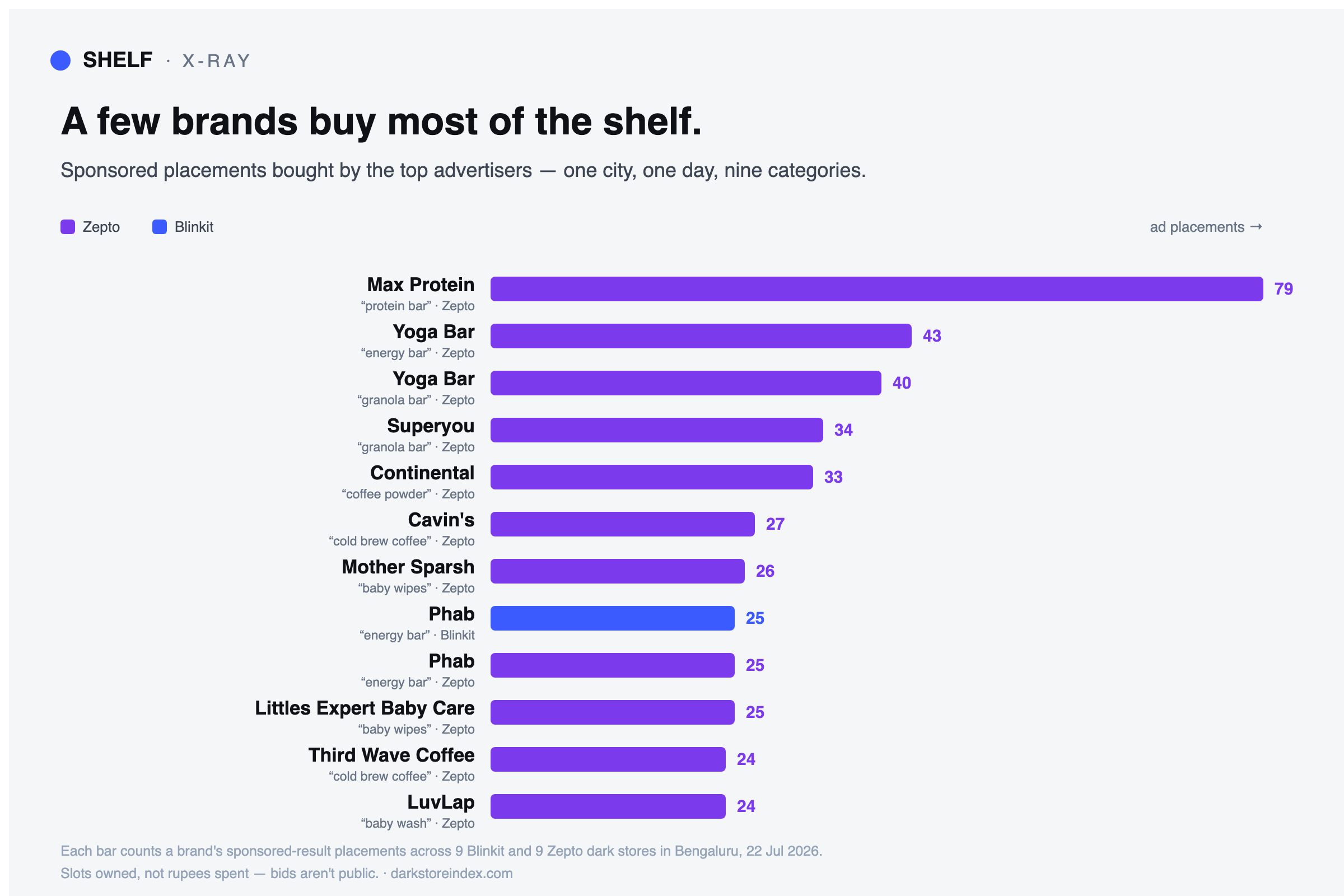
Zepto is a pay-to-play shelf. Blinkit isn't — yet.
The clearest split between the two platforms is advertising. In Bengaluru, every Zepto store we read had a sponsored result for every search — there was no uncontested shelf anywhere. On Blinkit, one or two stores per search had no advertiser at all: free top-of-shelf, if you knew which stores.
And the ads that do run are heavily concentrated. Eleven of the twelve biggest ad-buyers we found sit on Zepto. Within a category, one brand routinely dwarfs the rest — Max Protein on protein bars, Yoga Bar on energy and granola bars, Continental on coffee powder. If you sell in one of these categories and you're not in the chart above, a competitor is renting the shelf you're trying to earn.
The two platforms don't stock their stores the same way
The second split is availability. On Blinkit, 6 of the 9 searches we ran returned an empty shelf in at least one store — nothing at all — while another store nearby returned a full one. On Zepto, that happened zero times: every store returned a stocked shelf for every search, every time.
Coverage tells the same story. Counting how often a brand was present in fewer than all the stores we read, Blinkit had 63 such gaps to Zepto's 18. Blinkit's dark stores are far more uneven — which is a risk if you're absent from the wrong ones, and an opening if a rival is.
Why there's no single national shelf
Both effects come from the same mechanic. Every quick-commerce order is fulfilled from the dark store nearest the shopper — a small local warehouse serving a set of pincodes. Each one carries its own assortment, runs its own ads, and ranks results from its own local signals. So a brand's “national” presence is really a distribution across hundreds of local shelves that don't resemble each other. The mechanic is covered in why your rank differs in every dark store.
Your seller dashboard can't show you any of this. Not because it's a bad dashboard, but because competitor ads and rival presence are shopper-facing data. No seller portal on any platform contains them.
What this means for a brand
The two platforms ask for different things. On Zepto, you pay to be seen — the shelf is uniform and saturated with ads, and a single rival may already own most of your category's paid slots. On Blinkit, there's whitespace — uncontested keywords and thinner ad load — but no guarantee your category even shows up in a given store. Knowing which stores, and which categories one rival is quietly buying, is the difference between spending blind and spending where it moves the shelf.
What to do about it
Check the concentration in your category before you commit a budget. If one brand holds 60–100% of the paid slots, you are trying to dislodge an incumbent rather than entering an open auction — that needs a different number.
On Blinkit, hunt the uncontested stores first: they were 10 of the 81 store-searches we read, and they are the cheapest visibility on any of the three platforms. On Zepto and Instamart in Bengaluru there were none at all, so budget for a contested shelf from day one.
Public shelf reads across 9 individual Blinkit and 9 Zepto dark stores in Bengaluru, on one day, across coffee, protein bars and baby care. No seller account, no brand's private data, nothing supplied by anyone. A “sponsored placement” is a listing the platform returned as a paid (ad) result — slots owned, never rupees spent, because bids aren't public. An “empty shelf” is a store that was read successfully and returned no products for that search. One city, one day: a snapshot, not a trend.
See your own brand's shelf, store by store
This is category-level. To read where your brand sits in each of these stores — rank, stock, and who's advertising on your name — run it yourself. Free, no signup, nothing to connect. It works on any brand, including the ones you compete with.
Keep reading
- Blinkit advertising — who owns the sponsored slots, measured.
- The Dark Store Index — the full per-category reports with per-store tables.
- Why your rank differs in every dark store — the ranking mechanic.
- Brand-term conquest — when a rival advertises on your name.
- Glossary