Swiggy Instamart seller: registration — and the shelf you're joining.
Registration is a document exercise with a known checklist. What happens next is a shelf problem, and Instamart's shelf behaves differently from Blinkit's or Zepto's. We read nine Instamart dark stores in Bengaluru to show what you're actually walking into.
The Instamart seller portal is on Swiggy's own official seller site — go there directly to sign in. This page isn't a login portal, and you should never enter seller credentials on a third-party site, including this one. If you're after a delivery-partner or job role, Swiggy's careers pages are the right place.
Who Instamart onboards
Manufacturers, distributors, D2C brands and established sellers in groceries, FMCG and daily essentials, operating as a registered business with valid GST.
Like Zepto, Instamart onboarding runs through Swiggy's commercial team rather than a fully open self-serve signup. In practice that means category fit and demonstrable demand matter before you get in — it's closer to a supplier relationship than a marketplace listing. Swiggy sets the current terms, so confirm specifics with them directly rather than any third-party guide, including this one.
What registration takes
The commonly listed requirements across quick-commerce platforms are consistent: GST certificate, PAN, bank account details, proof of business registration, and an FSSAI licence for food products. Category-specific documents may be requested during onboarding.
Commission rates, delivery and packaging charges vary by category and are set during onboarding. Published figures floating around the web are indicative at best — nobody outside the platform sees the current rate card, and anyone quoting a precise universal number is estimating.
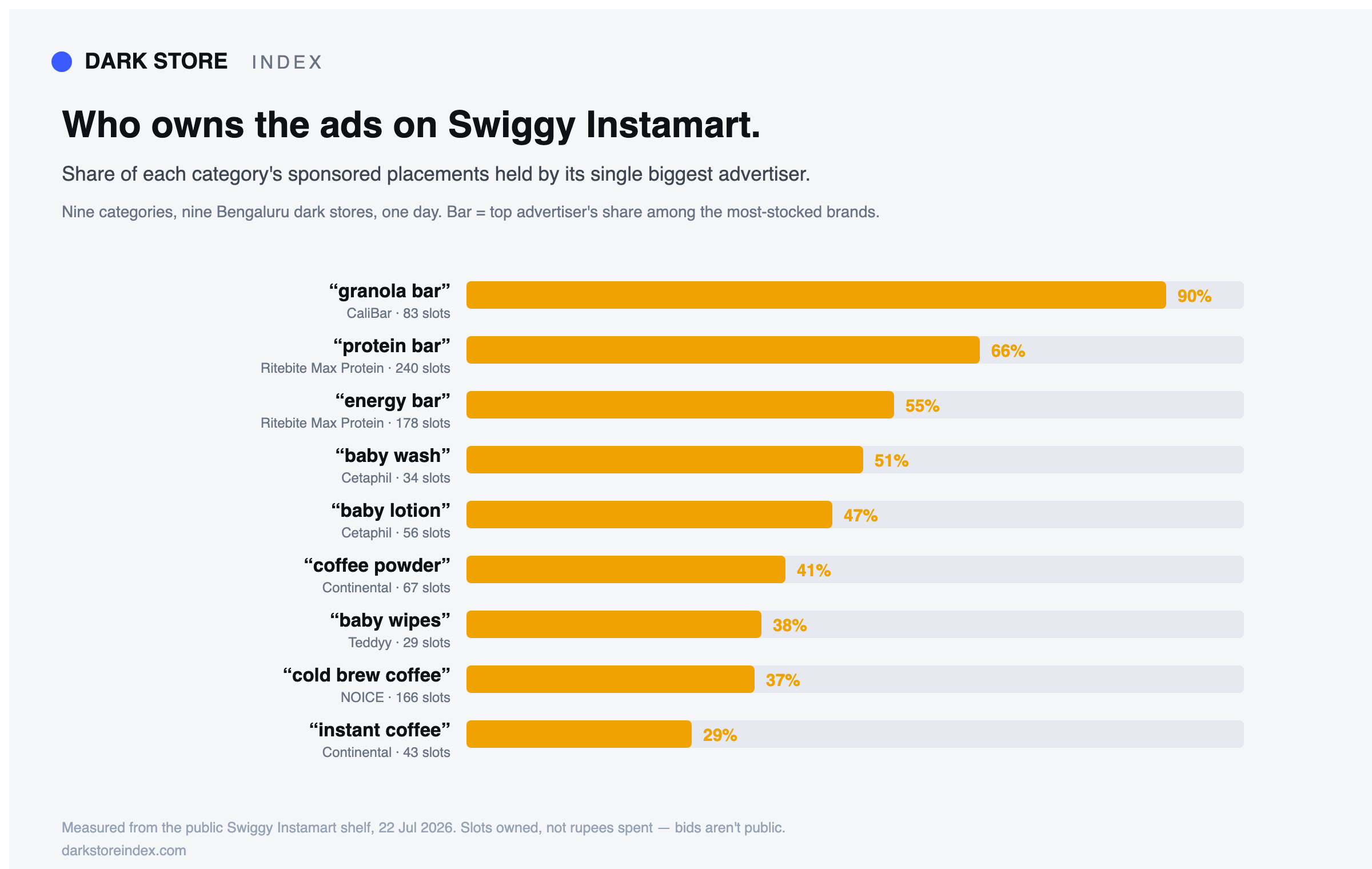
What the Instamart shelf actually looks like
This is the part missing from every other guide on this keyword. We read the same nine keywords across nine Instamart dark stores in Bengaluru, and the same nine across Blinkit and Zepto, on one day. Three things stand out for anyone about to list.
1. There is no free shelf space. Across all 81 store-and-search combinations in Bengaluru, every single one returned at least one sponsored placement — and Delhi NCR matched it exactly. On Blinkit, 10 of 81 had no advertiser at all in both cities. If you list on Instamart, you are competing with advertisers everywhere, from day one.
2. The assortment is remarkably consistent. In seven of the nine categories, every one of the category's most-stocked brands appeared in all nine dark stores. Instamart's stores resemble each other far more than Blinkit's do. Good news: you don't have to fight nine different assortment battles. Bad news: there's no quiet store to win first.
3. One brand often owns the ads. The largest advertiser in a category held between 29% and 90% of its sponsored placements. In granola bars, CaliBar held 90%. In protein bars, Ritebite Max Protein held 240 sponsored placements — 66% of everything paid in that category.
| Blinkit | Zepto | Instamart | |
|---|---|---|---|
| Store-searches with no advertiser | 10 of 81 | 0 of 81 | 0 of 81 |
| Distinct brands per search (avg) | 19 | 10 | 21 |
| Top advertiser's share of category ads | 31–100% | 21–70% | 29–90% |
What this means if you're listing
- Budget for ads from the start. On Blinkit you can find uncontested keywords and stores. On Instamart, in this sample, you can't — every shelf already has a paying brand on it.
- Check who owns your category before you commit. If one rival holds 60–90% of the paid slots, entering means a sustained fight, not a test budget.
- City-level reads are more useful here. Because Instamart's stores are consistent, what you learn from a few stores generalises better than it does on Blinkit.
- Don't rely on your seller panel for any of this. It shows your performance, not who is out-ranking or out-bidding you.
Public shelf reads across 9 individual Swiggy Instamart dark stores in Bengaluru on one day, across nine keywords in coffee, protein bars and baby care — plus the same nine keywords across 9 Blinkit and 9 Zepto dark stores for comparison. No seller account, no brand's private data. A “sponsored placement” is a listing the platform returned flagged as a paid result — slots owned, never rupees spent, because bids aren't public. Category shares are calculated among each category's most-stocked brands. One city, one day: a snapshot, not a trend.
See your brand's Instamart shelf, store by store
This page is category-level. To see where your products sit in each Instamart dark store — rank, stock, and which brand holds the sponsored slot above you — run your own brand through the tool. Free, no signup, nothing to connect. Works on any brand, including your competitors'.
Keep reading
- Blinkit seller guide — the same ground for the largest platform.
- Zepto seller guide — registration, the Seller Hub and what sells.
- Blinkit advertising — who already owns the sponsored slots.
- Blinkit vs Zepto: two completely different shelves
- The Dark Store Index — the full per-category reports.
- Glossary