Blinkit advertising: who's actually buying the shelf.
Most guides on this topic explain how to get an ad account. None of them tell you the thing that decides whether it's worth the money: who already owns the sponsored slots in your category, and which stores nobody is bidding on at all. That part is publicly observable, so we measured it.
Blinkit's advertising products are sold through Blinkit's own commercial team — go to Blinkit directly for access, formats and rates. This page isn't an ad platform or a login, and we don't resell Blinkit inventory. What's here is independent measurement of the shelf that results.
What one brand owning the category looks like
Across nine categories read in nine Bengaluru dark stores on the same day, the single largest advertiser in a category held between 31% and 100% of its sponsored placements. In granola bars, one brand — RiteBite — held every paid slot we counted among the category's most-stocked brands. Seven other well-known brands on the same shelf ran none.
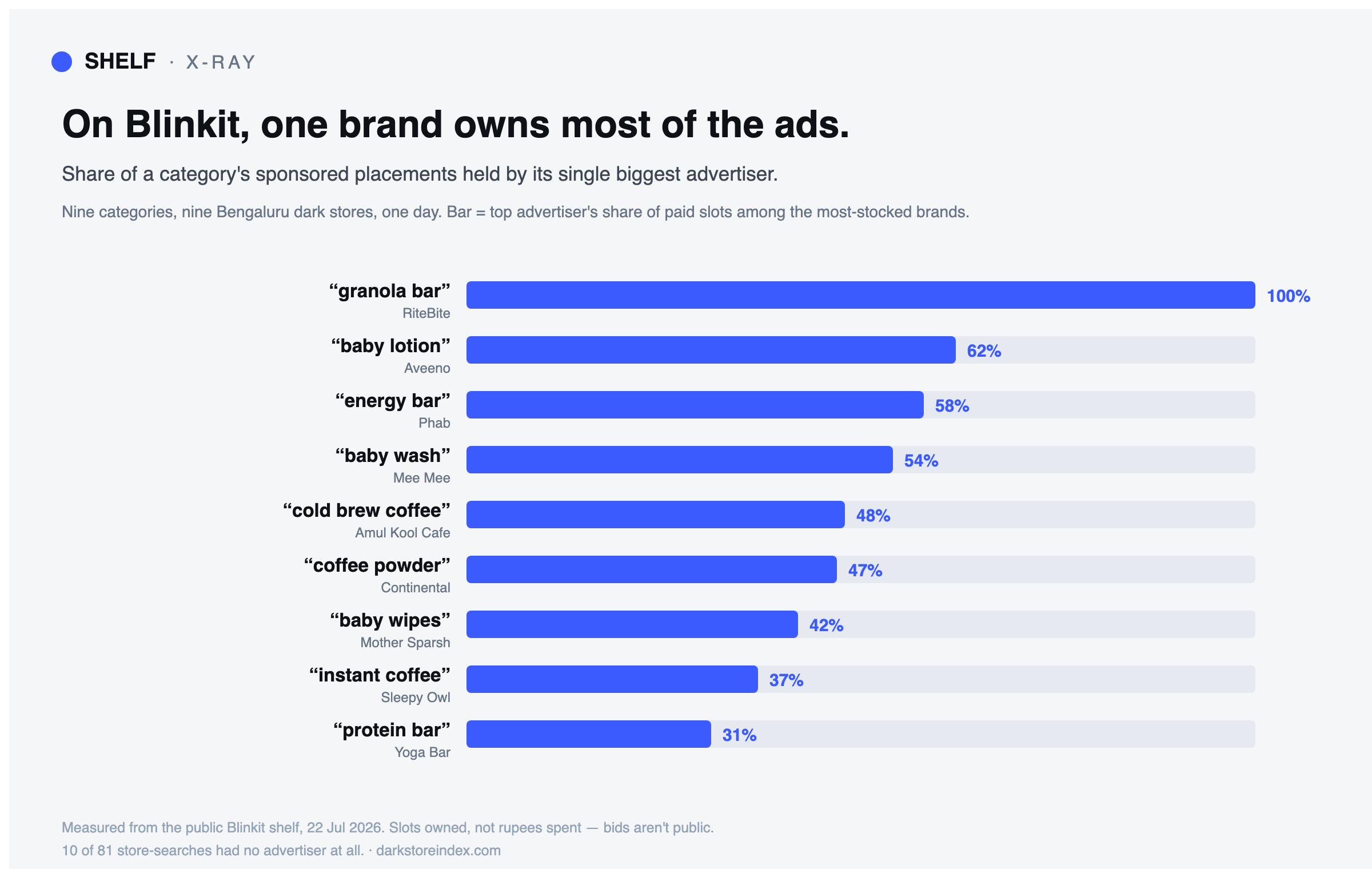
This is the number that should set your expectations before you spend. In a category where one rival holds 60–100% of the paid placements, you are not entering an open auction — you are trying to dislodge an incumbent who has already decided this category is worth owning. In a category where the top advertiser holds 31%, the shelf is genuinely contested and a modest budget moves you.
12% of the shelf had no advertiser at all
The more useful finding for a smaller budget: of the 81 store-and-search combinations we read on Blinkit, 10 returned no sponsored placement whatsoever. No one was bidding. That is roughly 12% of the shelf sitting uncontested — free top-of-shelf for whoever shows up first.
For contrast, we read the same nine categories across nine Zepto dark stores in Bengaluru and found zero uncontested store-searches. That did not hold in Delhi NCR, where Zepto returned 18 of 81 — see the second-city test.
Those gaps are not spread evenly. They cluster by store and by keyword — baby lotion and baby wipes each had two stores with no advertiser, while coffee powder had none. Which means the opportunity isn't “advertise on Blinkit,” it's advertise on these keywords, in these stores.
Most brands still aren't advertising
In every category we measured, between three and seven of the most-stocked brands ran no ads at all. These aren't small players — they're brands already winning shelf space on merit. The paid layer of Indian quick commerce is still thin, which is exactly the condition in which early advertisers get disproportionate returns.
It also means the competitive picture from a rate card is misleading. The real question isn't what a slot costs; it's how many of your actual competitors have decided to buy one. In most of these categories, the answer is still: not many.
What your seller dashboard won't tell you
Your Blinkit seller reporting covers your own performance — your orders, your spend, your listings. It does not show which competitor holds a sponsored slot above you in a given dark store, because that is shopper-facing data. No seller portal on any quick-commerce platform contains it.
That's the gap this data fills. Reading the public shelf per store shows the sponsored placements a shopper actually sees, which is the only view that tells you whether your ad budget is fighting an incumbent or walking into an empty room. If a rival is bidding on your brand name specifically, that's a related and separate problem — covered in brand-term conquest.
How to think about a Blinkit ad budget
- Check concentration before you commit. If one brand holds most of your category's slots, budget for a sustained fight or pick a different keyword. If the top share is under ~40%, the category is open.
- Hunt the uncontested stores. A keyword with no advertiser in two of nine stores is cheaper visibility than the same keyword city-wide.
- Count rivals, not rates. How many of your real competitors are actually buying slots matters more than the published cost of one.
- Re-check it. Ad ownership moves. A category that's open this month is exactly the kind a competitor notices next month.
Public shelf reads across 9 individual Blinkit dark stores in Bengaluru on one day, across nine keywords in coffee, protein bars and baby care, plus the same nine keywords across 9 Zepto dark stores for comparison. No seller account, no brand's private data. A “sponsored placement” is a listing the platform returned flagged as a paid result — slots owned, never rupees spent, because bids aren't public. Category shares are calculated among each category's most-stocked brands. One city, one day: a snapshot, not a trend.
See who's advertising against your brand
This page is category-level. To see which brands hold sponsored slots in the specific dark stores where your products sell — and which stores have no advertiser at all — run your own brand through the tool. Free, no signup, nothing to connect. Works on any brand, including your competitors'.
Keep reading
- The Dark Store Index — the full per-category reports.
- Blinkit vs Zepto: two completely different shelves — why the two platforms need different ad strategies.
- Blinkit seller guide — registration, the seller panel, and what sells.
- Brand-term conquest — when a rival advertises on your name.
- Glossary