Blinkit vs Zepto: what reading 9 dark stores shows about your shelf.
On quick-commerce platforms, a brand does not have “a rank.” It has a different rank in every dark store, at the same moment, for the same search. We read 9 Bengaluru dark stores by hand to show how far apart those shelves actually are — and the spread is much wider than most brands realise.
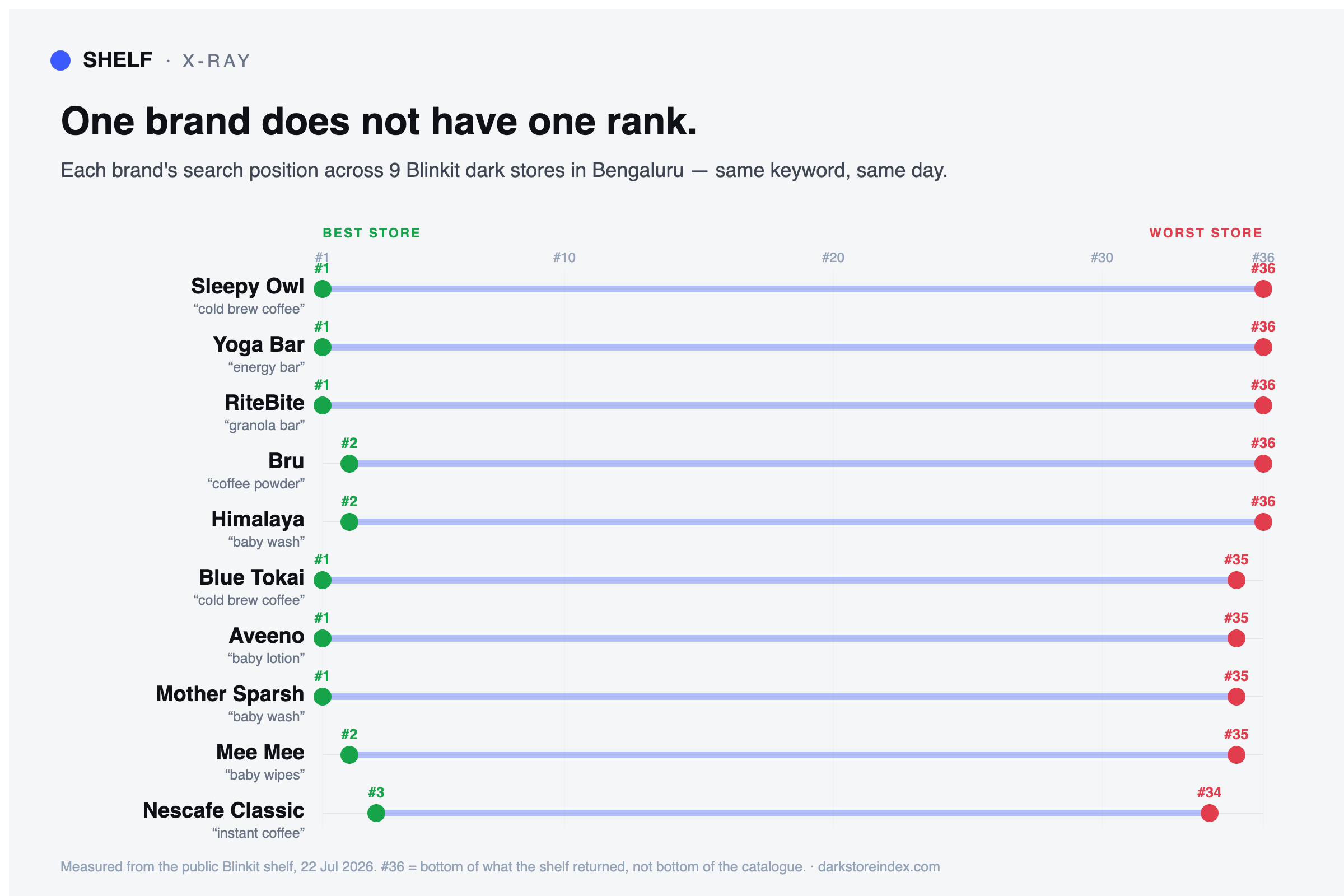
Sleepy Owl ranks #1 for “cold brew coffee” in one Bengaluru dark store and #36 in another. Same keyword. Same platform. Same day. Not a mistake, not a lag — it's how the system works.
Why there is no national shelf
Every quick-commerce order is fulfilled from the dark store nearest the shopper — a small local warehouse serving a set of pincodes. Each one carries its own assortment and ranks search results from its own local signals: what's selling there, what's in stock there, who's advertising there.
So your “national” position is an average of shelves that don't resemble each other. And the average hides exactly the stores where you're invisible — the ones handing local searches to whoever is showing up. The mechanic behind this is covered in why your rank differs in every dark store.
Your seller dashboard can't show you this. Not because it's a bad dashboard, but because competitor rank and rival ads are shopper-facing data. No seller portal on any platform contains them.
What 9 dark stores actually showed
Read from the public Blinkit and Zepto shelf across 9 Bengaluru dark stores, one day, across coffee, protein bars and baby care. Every figure below is measured, not modelled.
- Being everywhere isn't being visible everywhere. Bru appears in 100% of stores for “coffee powder” — and still ranks anywhere from #2 to #36 depending on which store you're standing in.
- Some stores simply don't carry a category. One store returned nothing at all for “cold brew coffee” while another returned a full shelf. If you're the brand that's absent there, you're not losing the ranking race — you're not in it.
- Uncontested shelf exists — on one platform. On Zepto, every single store we read had an advertiser for every search. On Blinkit, 1–2 stores had none at all: free top-of-shelf, if you knew which ones.
- The spread is the norm, not an outlier. Sleepy Owl ran #1 to #36 on “cold brew coffee”; Yoga Bar #1 to #36 on “energy bar”; Aveeno #1 to #35 on “baby lotion”; Nescafe Classic #3 to #34 on “instant coffee.” Ten well-known brands, ten wide ranges — on the same day.
The two platforms are not the same shelf
Blinkit carried the wider selection — around 21 distinct brands per search versus Zepto's 12. But Zepto was far more consistent store to store: its assortment depth swung by at most 9 products between its own stores, against 36 on Blinkit.
For a brand that's a real trade-off, not a preference: a wider shelf means more competitors listed but more inconsistency to exploit; a uniform shelf means fewer rivals but nowhere quiet to land.
Who's buying the shelf
Ad ownership is just as lopsided. Slots aren't split evenly — a single brand can hold most of a category's paid placements while a direct rival buys none. The starkest case we read: on Zepto, Max Protein held 79 sponsored slots for “protein bar” — in a category that showed only 6 distinct brands in total. These are slots owned, not rupees spent; bids aren't public.
| Brand | Keyword | Platform | Slots owned |
|---|---|---|---|
| Max Protein | “protein bar” | Zepto | 79 |
| Yoga Bar | “energy bar” | Zepto | 43 |
| Yoga Bar | “granola bar” | Zepto | 40 |
| Continental | “coffee powder” | Zepto | 33 |
| Cavin's | “cold brew coffee” | Zepto | 27 |
| Phab | “energy bar” | Blinkit | 25 |
| Amul Kool Cafe | “cold brew coffee” | Blinkit | 21 |
| Aveeno | “baby lotion” | Blinkit | 18 |
| Yoga Bar | “protein bar” | Blinkit | 16 |
| RiteBite | “protein bar” | Blinkit | 14 |
Why this matters for a brand
If you sell on quick commerce, the useful question was never “what's my rank.” It's which stores, and what changed. A rank on one day is a photograph. What moves week to week — a store that dropped you, a rival that started advertising on your name in three neighbourhoods — is the thing you'd actually act on. None of that is visible from a single national number, and none of it is in your panel.
Public shelf reads across 9 individual Blinkit and Zepto dark stores in Bengaluru, on one day. No seller account, no brand's private data, nothing supplied by anyone. Rank is position within the results each store returned — a worst rank of #36 means “bottom of what we could read in that store,” not bottom of the catalogue. Ads are counted as sponsored slots owned, never rupees spent — bids aren't public. One city, one day: a snapshot, not a trend.
See your own brand's shelf, store by store
This is category-level. To read where your brand sits in each of these stores — rank, stock, and who's advertising on your name — run it yourself. Free, no signup, nothing to connect. It works on any brand, including the ones you compete with.
Keep reading
- The Dark Store Index — the full per-category reports with per-store tables.
- Why your rank differs in every dark store — the ranking mechanic.
- Brand-term conquest — when a rival advertises on your name.
- Glossary