The quick-commerce shelf is not national. Here are 486 stores of proof.
Almost every published figure about Indian quick commerce — how a platform ranks, who advertises, what's in stock — is a single sample presented as a general truth. But there is no single shelf. Each dark store carries its own assortment, ranks from its own local signals, and sells its own ad slots. We read 486 dark stores across three platforms and two cities to show what the shelf actually looks like — including one of our own findings that a second city broke within 48 hours.
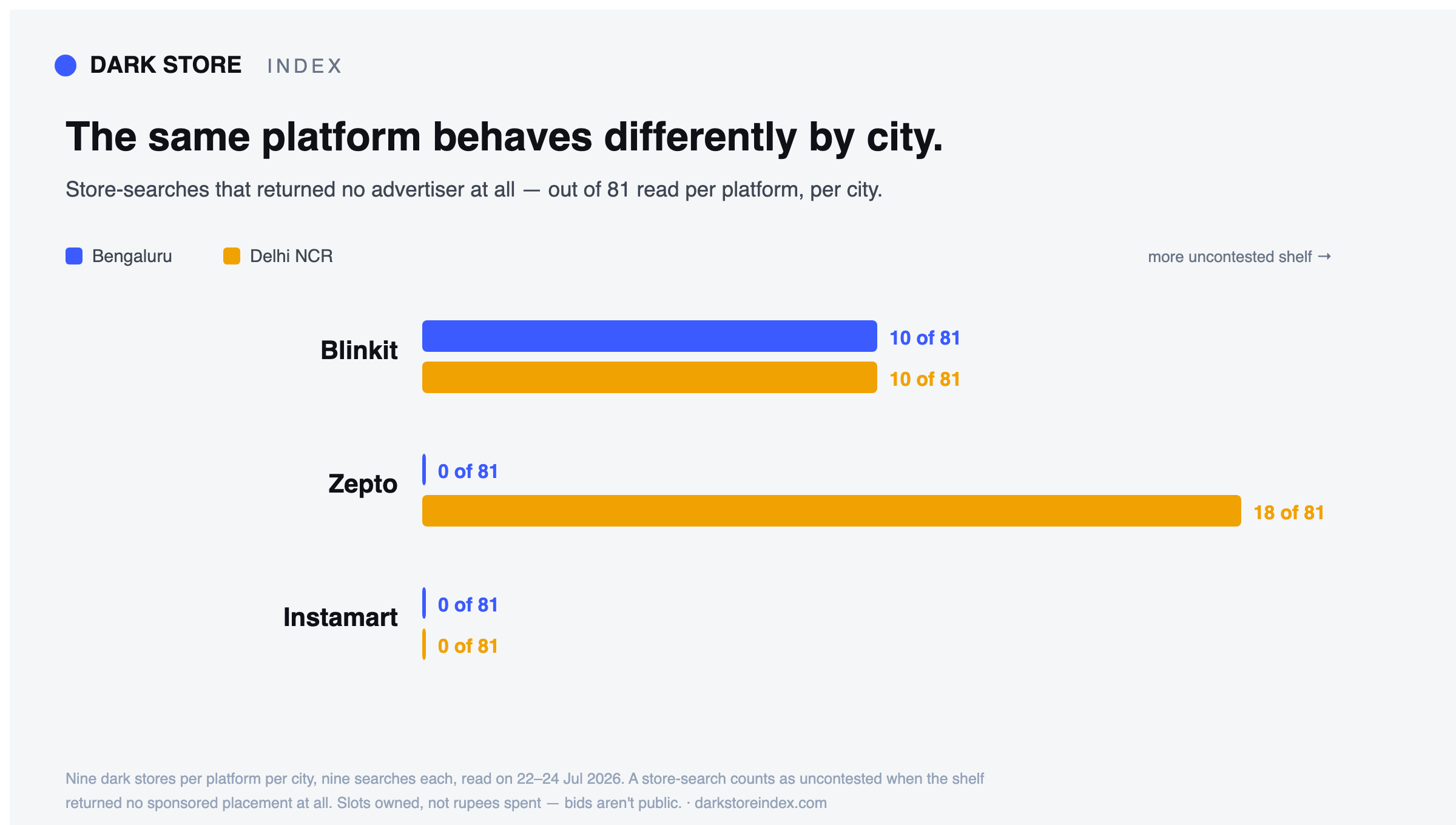
Same nine searches, nine dark stores per platform per city, Bengaluru and Delhi NCR. Blinkit returned an identical 10 of 81 uncontested store-searches in both cities. Instamart returned 0 of 81 in both — someone was paying in every store, every search, both metros. Zepto went from 0 of 81 in Bengaluru to 18 of 81 in Delhi NCR: the same platform behaving like two different companies.
Blinkit: the same shelf in two cities
Blinkit was almost eerily consistent. Exactly 10 of 81 store-searches returned no sponsored placement in Bengaluru, and exactly 10 of 81 in Delhi NCR. Different city, different stores, different assortment — the same proportion of uncontested shelf. That is a stronger result than either city alone: it suggests Blinkit's ad density is a platform-level property, not a local accident. It is also the only platform-level claim on this page we would stand behind, precisely because two cities agreed.
Instamart: no quiet corner, and one brand owning a category
Instamart had no uncontested shelf in either metro. Zero of 81 store-searches came back without a sponsored placement in Bengaluru; zero of 81 in Delhi. If you sell on Instamart, there is nowhere to land for free in either city.
And one advertiser came close to owning a whole search term. Ritebite Max Protein held 240 sponsored placements on the “protein bar” search on Instamart in Bengaluru — 66% of everything paid on that one search — and 266 placements, 93%, in Delhi NCR. Widen from the single search to the full protein & energy bars category (three searches: protein bar, energy bar, granola bar) and the same brand holds 418 slots, 54% in Bengaluru and 510 slots, 89% in Delhi NCR. Both figures are the same reads counted at different widths — which is the point: a share is meaningless without the scope it was measured over. Placements owned are what we count, never rupees spent: bids are not public, and we will not estimate them.
Zepto: a different company in each city
Zepto is where the "national shelf" idea falls apart hardest — and where we caught ourselves.
- Uncontested shelf went from 0 to 18 of 81 store-searches between Bengaluru and Delhi NCR.
- Empty stores appeared. In Bengaluru, no Zepto search returned an empty store in any category. In Delhi, every one of the nine searches had at least one store return nothing at all for it.
- Ad concentration loosened. The top advertiser's share of a category's paid placements was markedly lower in Delhi than in Bengaluru.
We had published the Bengaluru result — "Zepto has no uncontested shelf anywhere" — without a city qualifier. Delhi disproved it in 48 hours. We wrote up the correction in full rather than quietly editing it: we tested our own finding in a second city, and it broke.
What this means for anyone reading quick-commerce numbers
The headline is not any single figure above — it is that the figures move. A platform's behaviour, a category's ad ownership, a brand's presence: all of it changed between two cities read two days apart. So when you next see a claim about how Blinkit or Zepto or Instamart behaves, the useful question is the one we now ask of our own work: measured where, on what date, across how many stores?
Most coverage of this market — including ours until 24 July — can't answer that, because it comes from one sample. The only honest way to talk about the quick-commerce shelf is per store, per city, with the date attached.
Nine searches across coffee, protein bars and baby care, read in 9 dark stores per platform per city in Bengaluru (22 July 2026) and Delhi NCR (24 July 2026) — 486 store reads in total, across Blinkit, Zepto and Swiggy Instamart. Public shopper-facing shelf only; no seller accounts, no brand-supplied data. A store-search counts as uncontested when the shelf returned no sponsored placement at all. Advertising is counted as slots owned, never rupees spent, because bids are not public. A store we could not read is recorded as unread, never as absent. Worst-rank figures are deliberately not published: result lists are capped, so the lowest rank seen is a floor on the read, not a measurement. Two cities on two days is a small sample — enough to disprove a general claim, not to prove one.
The Dark Store Index, “State of the Quick-Commerce Shelf” (2026) — darkstoreindex.com/state-of-the-quick-commerce-shelf. Journalists and researchers: the full store-level dataset behind these figures is available on request at hello@darkstoreindex.com.
Your brand's shelf is this local too
If a platform behaves this differently between two metros, so does your shelf. Read your own brand store by store, in the cities you actually sell in — rank, stock, and who's advertising on your name. Free, no signup.
Keep reading
- We tested our own finding in a second city. It broke. — the full correction.
- Blinkit vs Zepto: two completely different shelves
- Who's actually buying the Blinkit shelf
- Delhi NCR protein-bar report · Bengaluru
- Blinkit analytics · Zepto · Instamart — who ranks and who's advertising, by brand and platform.
- Our method, and its limits